Showing posts with label Climate Change - Global. Show all posts

Tuesday, October 22, 2019

Strong El Ninos due to climate change: new study!


A new study finds out that climate change is making stronger El Ninos, which change weather worldwide and heat up an already warming planet.  Examining 33 El Ninos since 1901, the scientists who conducted this study found that since the 1970s, El Ninos have been forming farther to the west in warmer waters, leading to stronger El Ninos in some cases.

A powerful El Nino can trigger drought in some places, like Australia and India. And it can cause flooding in other areas like California. The Pacific gets more hurricanes during an El Nino and the Atlantic gets fewer.
Read further here: http://bit.ly/2o7Me4t


Monday, September 23, 2019

Scientists warn us again: Emergency Climate Action needed!


As we prepare to stand in solidarity with the Global Climate Strike today, this alarming news from scientists knock our doors again asking for emergency actions to face the unprecedented impacts of climate change. A landmark new report #UnitedInScience, compiled by the UN World Meteorological Organization (WMO), and that is to be presented to the UN Climate Action Summit, underlines the glaring – and growing – gap between agreed targets to tackle global warming and the actual reality.

The UN has reported that among other findings, the report says that accelerating climate impacts from melting ice caps to sea-level rise and extreme weather were to blame for the record as the global average temperature increased by 1.1°C above pre-industrial (1850-1900) times and 0.2°C warmer than 2011-2015. It highlights the urgency of fundamental socio-economic transformations and carbon-curbing actions in key sectors such as land use and energy to avert dangerous global temperature increase, with potentially irreversible impacts. It also examines tools to support both mitigation and adaptation.

While the world leaders will discuss the details in the UN Climate Summit, let’s do our bit.  Join us at Budharaja foot hills, Sambalpur at 4 pm today (23rd September) in a silent #ClimateStrike in support of the #GlobalClimateStrike. 


For further details and to participate in today’s strike, please contact us at:

Ranjan Panda

Convenor, Water Initiatives
Mahanadi River Waterkeeper (Member, Global Waterkeeper Alliance, New York)
Convenor, Combat Climate Change Network, India


Tweets @ranjanpanda
Tweets @MahanadiRiver


Thursday, May 30, 2019

2019 Global Youth Video Competition: Last date to apply - 28 July 2019!


The UNDP-implemented GEF Small Grants Programme (SGP) has announced its 2019 Global Youth Video Competition.

This year, the fifth edition of the video competition aims to mobilize global youth around the Climate Action Summit organized in Sept 2019 by the United Nations Secretary-General António Guterres.

The competition is led by the Secretariats of the three Rio Conventions: the United Nations Framework Convention on Climate Change (UNFCCC), the Convention on Biological Diversity(CBD) and the United Nations Convention to Combat Desertification (UNCCD), in partnership with the GEF Small Grants Programme (SGP), implemented by the United Nations Development Programme, and Television for the Environment (TVE).

Please note the following conditions:

  • Entrants must be between 18 and 30 years of age + should submit a maximum 3-minute video by 28 July 2019 on one of the themes outlined below;
  • Judging panels composed of representatives of the three Rio Convention secretariats will pre-select a short list of videos in each category based on the criteria of content, innovation, originality, impact, and technical expertise;
  • Pre-selected videos will then be posted online to be voted on by the public;
  • One winner will be selected per category. The three winners will attend and screen their films at the UNFCCC COP25 in Santiago, Chile, in Dec 2019;
  • Winning videos will also be screened in front of a global audience at the UNCCD COP14 in New Delhi, India, in Sept 2019.

The three themes are as follows:


For further information and to apply online, please visit: www.biomovies.tve.org

So folks, start preparing for your entries.  Let us know if we can help us in building ideas.  

Best wishes,

Ranjan Panda
#Youth4Water campaign


---
Water Initiatives, Odisha
Combat Climate Change Network, India
Mahanadi River Waterkeeper (Member, Global Waterkeeper Alliance)
Country Manager for India, Climate Scorecard Project

Email: ranjanpanda@gmail.com 

Monday, February 25, 2019

People losing out to sea, traditional fishing losing out to unsustainable practices: Vizag Field Diary


Pic from the field trip to Mangamari peta, Vizag during Media Workshop on Climate Change, Climate Justice and Resilience in #BayOfBengal organised by #Internews , #EarthJournalismNetwork and #ThirdPole.  I joined the programme as a Resource Person to speak on Freshwater Challenges in Bay of Bengal due to climate change. 


Knowledge of responsible fishing is a matter of the past. Such old men find it hard to convince the young generations and hence surrender to the new unsustainable methods themselves. Market demands the fishermen to harvest as much fish as they can. The sea is bouncing back, giving more and more dry days. And when the bumper catch happens, a huge chunk of that goes waste. Climate change and pollution as such play spoilsport, driving away the younger generation from this traditional occupation.

Ranjan Panda
Convenor, Water Initiatives
Convenor, Combat Climate Change Network, India

Email: ranjanpanda@gmail.com 
Tweets @ranjanpanda 
            @MahanadiRiver

Thursday, January 31, 2019

Inviting Organisations and Individuals to partner in River Conference: Forest-River-Communities-Climate Change


Hi All,

Greetings from India!

A ‘River Basin Approach’ in ‘Nature Based Solutions’ by ensuring rights to local and indigenous communities over the local natural resources with involvement of all stakeholders can offer some of the best solutions to growing water woes and climate change crises. That’s what we want to explore further in our exciting upcoming River Conference (3rd Odisha River Conference) scheduled for 24-25 March 2019 with the following theme:

Promoting the Forest-River-Communities nexus for Conservation of Rivers and Combating Climate Change
The conference will see a unique gathering of forest protecting communities, civil society organisations, experts, academia and other stakeholders at Baripada in the eastern state of Odisha.  Baripada in Mayurbhanj district, famous for the Simlipal bio reserve and a perfect test case to understand intricate linkages between forests, rivers and indigenous communities. 

The Conference agenda has significance both at national and global context for people working on these issues and who are interested in taking up suitable action and advocacy initiatives surrounding the theme.  We plan to have two general sessions, four technical sessions and a River Festival by indigenous communities residing in the Similipal bio reserve showcasing their relationship with the rivers and forests. 

Would you be interested to be part of this unique initiative?  If you want to collaborate or participate, please write to me for further details. Our last River Conference in 2018, organised around inter-state cooperation in river basin management, saw collaboration of 25 organisations and many individuals and witnessed active participation of about 150 people from cross section of stakeholders. We expect more encouraging response this time.

Thanking you,
Warm regards,

Ranjan

-- 
Ranjan K Panda

Convenor, Water Initiatives Odisha (WIO)
Mahanadi River Waterkeeper (Member, Global Waterkeeper Alliance, New York)

Convenor, Combat Climate Change Network, India
Country Manager for India, Climate Scorecard Project (Boston, USA)

Mobile: +919437050103
Email: ranjanpanda@gmail.comranjanpanda@yahoo.com

Skype: ranjan.climatecrusader

Tweet @ranjanpanda
Tweet @MahanadiRiver

Blog: http://www.climatecrusaders.blogspot.com/

Fighting water woes, combating climate change...25 years and on!

Friday, January 25, 2019

Mismanagement can worsen Odisha extreme rainfall events - Ranjan Panda in India Climate Dialogue


As climate change makes extreme rainfall events more frequent in the Mahanadi River basin in Odisha and Chhattisgarh, there is urgent need to better manage the river and its dams
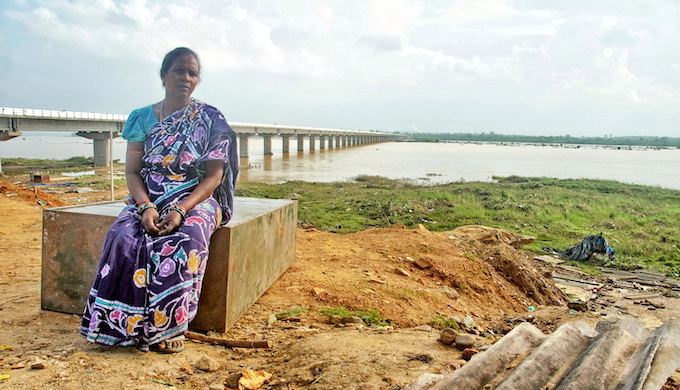
Nothing much remains of Manju Seth’s house after the extreme rainfall last July (Photo by Ranjan Panda)
Extreme precipitation events are the new normal in India. Of the recent disasters related to such extremes, the Kerala deluge haunts the national memory the most. The World Meteorological Organisation (WMO), in its latest State of Global Climate report, noted that among the extreme weather events in 2018, the Kerala floods caused the maximum number of casualties globally.
As the debate is yet to settle whether extreme rainfall or faulty management of dams were to blame for the Kerala floods, in the eastern state of Odisha, the Hirakud dam — arguably Asia’s longest earthen dam and blamed for many floods – is up for another challenge: extreme precipitation events.
Last monsoon, fortunately enough, a disaster was averted due to sheer luck. Fortunately, the date of massive rainfall and that of dam’s floodwater release missed each other by a few days. The debate over extreme precipitation events and urban flooding currently centres more around large cities, but smaller cities adjacent to dams need to be seriously watched and preparations for building their resilience to such extreme events need to be built. This case tells us why.
Manju’s plight
On July 27 last year, Manju Seth, a lady in her mid-forties, was busy gathering all that remained in the riverbed where she had a small hut just a week ago near Kachheri Chhak Ghat of Mahanadi River in Sambalpur. The district administration on July 20 had forced her and 13 other families dwelling in the place to evacuate their dwellings because Hirakud dam was to release the first lot of floodwaters on July 24.
Manju was reluctant and so were all the other families. They had been asked by the district administration to stay on the riverbed just about a year ago, when they were displaced from a slum on the river bank to give way to a bridge being built across the Mahanadi. “We had been living here at the Kachheri Chhak for more than 50 years, and when they decided to build a bridge they just asked us to vacate. Where would we go?” asked Manju, who works as a maid, sweeping homes, cleaning utensils and washing clothes for some well-off families of the city.
Ironically, the district administration had supplied electricity to this new habitation a few months ago, knowing very well that a riverbed cannot be a permanent settlement. “We were not sure about the rains and water this time, as for the last 3-4 years the water level had not touched this side of the river bed where we built our houses,” she said. This time, the rainfall was scary for Manju and for the whole district.
While the district administration had not yet fully realised the dangers of an extremely heavy rainfall that was making its way to the city, it kept persuading Manju and others to vacate the place and shift to a flood shelter. “They were evacuated because the dam was to release first lot of floodwaters on July 24. What surprised us was that on July 21 and 22, just after they were asked to shift to a flood shelter in Chhanrpur Jharapali village on the other side of the river, the city received unprecedented rainfall, something that has not seen since 1982,” said Jagdish Mishra, a local social activist.
Extreme rainfall
On July 21, when heavy rainfall lashed most parts of the state and the government’s attention was concentrated on the state’s capital city of Bhubaneswar, Sambalpur, just downstream of Hirakud, was drowning as well. Burla, the city on the other end of Hirakud dam, received as high as 622 mm of rainfall in a day, breaking a 36-year-old record of the district. See: Act now to spur urban climate resilience
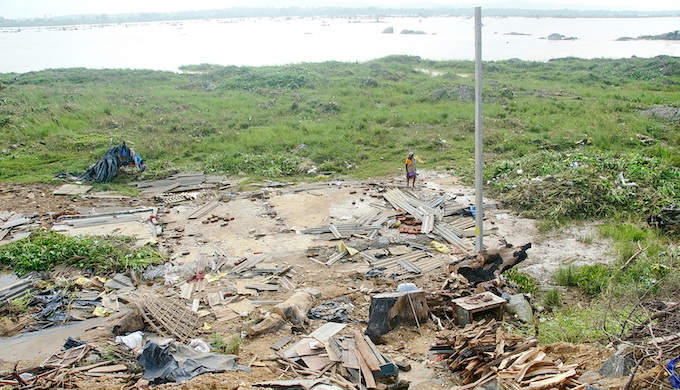
Fourteen houses of poor and internally displaced people on the Mahanadi riverbed were washed out after heavy rainfall (Photo by Ranjan Panda)
It was almost 41% of the entire year’s rainfall. More than half of the city was engulfed in water. Reports of the administration said that this rainfall affected at least 125,000 people and damaged more than 700 homes. Around 2,500 people were provided shelter in 22 relief camps and at least one person died.
The Hirakud reservoir was swelling that day as more than 100,000 cusec of water was entering into the reservoir for incessant rains upstream in Chhattisgarh that borders Odisha in the north. For four days prior to the Odisha rains, the dam was being filled with more water from the upstream state. On July 20, at night at around 9 pm, the water level had crossed 608.62 feet. The dam, which has been failing in controlling floods, runs into safety risks at such levels of water.
In 1982, Sambalpur had received 582 mm rainfall that had engulfed almost two thirds of the city under floodwaters. The city had never seen such a flood before. One of the main roads of the city, that runs parallel to Mahanadi River, breached because a major drain carrying both backwater of the Hirakud reservoir and rainwater forced its way to the river.
The city’s planning took a major shift after that. Strengthening embankments became a priority along with strong sluice gates on these drains at points they join the river. Sambalpur is on the bank of Mahanadi River, just about 10 km downstream the Hirakud dam, built in 50s. The region is now prone to increased number and intensity of extreme precipitation events, partly due to climate change.
Boon or bane?
“The Hirakud dam that was built to control floods in the delta districts of the river 300-400 km downstream has not only been unsuccessful in doing that but also has increased the floods in the upstream districts such as Sambalpur, where flood was not known earlier,” said Arttabandhu Mishra, a retired teacher from the Sambalpur University who has studied the Hirakud dam extensively.
This dam, spreading over 746 sq. km — almost half of the size of Delhi — is the only major dam project and flood control system on the 858 km long Mahanadi River, India’s sixth largest river, that drains an area of around 141,600 sq. km. The two major riparian states — Chhattisgarh and Odisha — have locked horns over the sharing of water of this river and the conflict centres around reducing flow of water from the upper state (Chhattisgarh) due to construction of a number of dams and barrages.
A major area of the conflict that does not make news is the potential of increased flood disasters due to increased number of dams and barrages being built upstream of Hirakud. Even though Odisha has raised this point during a Chief Ministerial level meeting held on the conflict, both the states have not chalked out any joint mechanism to streamline and strengthen coordinated flood management strategies.
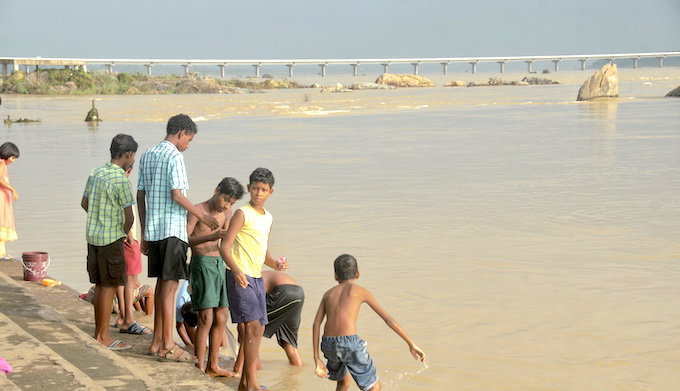
Sambalpur city on the bank of Mahanadi River just downstream of Hirakud dam is most vulnerable in changing climate scenarios (Photo by Ranjan Panda)
Civil society organisations such as the Water Initiatives Odisha (WIO) have been consistently raising concerns about the failed flood management in the Hirakud, alleging that the so-called rule curve that is followed in managing the inflow and outflow of floodwaters during the monsoon has drastically failed in factoring issues such as developments upstream that changes the flood flow, and climate change that increases rainfall variability. The Comptroller and Auditor General has also rapped the state government for failures in flood management due to similar reasons.
Future dangers
The heavy downpour that happened in July cannot be ignored any further as a stray event. Studies point to dangerous trends that grip the river basin already. Mahanadi is already facing increased high floods and researchers attribute this to climate change. A study by researchers from Indian Institute of Technology, Kharagpur, published in the Journal of Hydrology concludes, on the basis of their analysis pertaining to post-Hirakud dam construction period, that the recent incidences of high floods in the Mahanadi basin is due to an increase in extreme rainfall in the middle reaches of the basin. It means the extreme rainfall received at Sambalpur in July this year is a new normal and threat.
“The summer monsoon is very important for agrarian countries like us as it brings 80% of the rainfall and that’s going to be impacted due to increased extreme precipitation events,” Sandeep Pattnaik of IIT Bhubaneswar said. Pattnaik is co-author of the research paper titled Ramifications of Atmospheric Humidity on Monsoon Depressions over the Indian Subcontinent that has been published in the Nature Scientific Reports.
“There has been a constant increase in extreme rainfall events over central India during 1950-2015 and it’s going to increase as the surface gets warmer,” he said. “We have studied four monsoon depressions, three of which are from the Bay of Bengal and have found out that the Mahanadi catchment area will experience increased extreme precipitation events.”
New approach needed
Manju survived the rainfall all because the river was still dry and Hirakud had not released any floodwater. Manju and others were demanding permanent rehabilitation and at a place close to the city. “I have three children and the elder girl is studying in class 10th. This is a critical year and we cannot manage her studies from a faraway place,” she said. Her struggle for rightful rehabilitation will continue, as will be the case of the millions who are displaced by disasters in the country, and live in dingy informal settlements.
The city of Sambalpur with its 335,000 people, and other places downstream, cannot be complacent any longer, knowing the fact that flood events due to extreme precipitation are going to grow and cities like Sambalpur will be at the receiving end. There is an urgent need to integrate city planning with climate change induced calamities. We just can’t leave it to luck, as there is no guarantee we can avoid days of extreme precipitation coinciding with those of floodwater release from the dam.
“There are various lacunae in our current data generation methods. We don’t have high-density surface observation systems. The existing weather stations are too less and their recordings can miss the complete picture,” Pattnaik said. “While high-density weather observation stations are needed starting from catchment areas to the delta, a proper cooperation and coordination between both the states is also vital.

This article is being reproduced from India Climate Dialogue.  The link to the original article can be accessed at https://indiaclimatedialogue.net/2019/01/09/mismanagement-can-worsen-odisha-extreme-rainfall-events/

Friday, October 19, 2018

$43 mn Green Climate Fund to support Coastal resilience

This project will be implemented in Odisha, Andhra Pradesh and Maharashtra for Mangrove restoration, building community resilience and other aspects for 6 years to support India's Paris Goals.

More here: http://adaptation-undp.org/green-climate-fund-approves-us43-million-undp-supported-project-boost-climate-resilience-millions

Ranjan Panda
Convener, Combat Climate Change Network, India

Email: ranjanpanda@gmail.com

Tweets @ranjanpanda
Tweets @MahanadiRiver

Monday, October 15, 2018

Titli Update: Storms and aftermath - pollution of the Sea - Ranjan Panda


(Image: FB page of Special Relief Commissioner, Odisha)


The Very Severe Cyclonic Storm "Titli" has done a lot of damage to Odisha coasts, with high speed wind and the extreme rainfall that followed.  Titli crossed the coast near Palasa in Srikakulam district of Andhra Pradesh to the southwest of Gopalpur with estimated maximum sustained surface wind speed of 140-150 kmph gusting to 165 kmph between 0430 and 0530 hours IST of 11th October 2018.

Like the Phailin in the same time of the year, back in 2013, the rainfall in the aftermath caused floods and other devastation that the government had not anticipated well.  About 24 human deaths and more than 24000 livestock casualty recorded so far.  The actual figure may be more.  There is no estimate available for the casualty suffered by wildlife. A television news channel report this morning showed how elephants were being washed away due to heavy floods in Mahanadi but I could not confirm the details as yet. 

The heavy downpour that followed the landfall of Titli flooded the Rushikulya and Vanshadhara rivers affecting 16 districts of Odisha.  As per reports shared by the Special Relief Commissioner of the state, more than 5.7 million people in 7229 villages of these districts have been affected by the rainfall and the floods.  Agriculture in these villages has received a heavy jolt as more than 2.3 hundred thousand hectare of crop fields have been damaged.    

Going beyond politics, some real questions need to be asked -

Odisha's opposition parties are already criticising the state government for not being able to keep its promise of 'zero casualty' but the government seems to have given more attention to the relief and rehabilitation works, rightly so. 

The political debate will not settle soon. We will all participate in that, to understand where the failure lay and how to change our plans in future. Did the weatherman fail in proper predictions of the aftermath? Did the government fail to gauge the gravity of the predictions?  Did the local administration not act in line with the Disaster Management Plan? Did the local Disaster Management Committees (supposed to have been formed and trained by the government and other agencies) failed in carrying out the due procedures?  All these questions will haunt the state of Odisha that's currently engaged in relief and preliminary rehabilitation efforts.

The Debris that go into the sea –

In this post I am trying to flag an important issue that is normally not discussed as a major issue in such storm stroke aftermaths.  I am talking about the debris that is washed away from the inlands to the sea.  Today morning Himanshu Thakkar of SANDRP twitted to me a video https://youtu.be/9wazyFvJZbU that shows how the mouth of Rushikulya river has received loads of garbage and other debris due to Titli and floods. 

(Image: Screen shot of YouTube Video by Times of India)

We often forget that our rivers are carriers of all our wastes into the sea throughout the year, more so during the monsoon months.  Disasters such as this add to the force of the water that go into the sea and bring along more of our wastes into the sea.  Earlier I have already written extensively how plastic pollution of the sea is causing huge damage to the oceans as well the earth.  http://bit.ly/2QRjOEB

(Image: Screenshot from my article published in www.sixdegreesnews.org)

Time our disaster planning factors in these menaces along with other damages being done.  Climate change is already causing more storms and aggravating the damages.  Some studies point out that the frequency of storms in the Bay of Bengal is increasing, more than any other bay, due to climate change. 

We need to combine our brains on this and have more discussions, studies and action plans. 


Ranjan Panda

Convenor, Combat Climate Change Network, India

Skype: ranjan.climatecrusader

Tweets @ranjanpanda
Tweets @MahanadiRiver  

Friday, October 12, 2018

Commons help us fight extreme precipitation events!

#Commons help us adapt to #extremeprecipitation caused flash #floods & related woes. Let's protect them in both #urban & #Rural areas...

#CommonsAwarenessWeek #CAW

Thursday, October 11, 2018

Chilika lake under increased risk of climate change!

As the state of Odisha engages itself with relief & rehabilitation activities, some larger challenges need to be addressed. Increased #stormsurges are caused in the #BayOfBengal by #climatechange.
Severe #CyclonicStormTitli

Ranjan Panda
Convenor, Combat Climate Change Network, India

Email: ranjanpanda@gmail.com

Tweet @ranjanpanda
Tweet @MahanadiRiver

8 killed in AP: Severe Cyclone Titli update

Severe #CycloneTitli updates!

https://m.hindustantimes.com/india-news/eight-killed-lakhs-without-power-as-cyclone-titli-slams-andhra-odisha/story-8bBZjpA2VrzU4hC6nOuE1N_amp.html?__twitter_impression=true

Wednesday, October 10, 2018

Conserve commons to fight disasters: Ranjan Panda

Commons help us fight impacts of #disasters. Let's conserve #commons for our own survival and progress...
#CommonsAwarenessWeek #CW

Monday, October 8, 2018

My response to IPCC 1.5 Deg C Report: Indigenous People, Natural Solutions key - Ranjan Panda


Indigenous Communities and Natural Solutions key to achieve 1.5 Deg C target: My quick response to IPCC SR15 – Ranjan Panda

Just released: The much awaited IPCC report on climate projections at 1.5ºC level as against the previous estimations that had been done keeping in view the 2ºC level.

The report, known as The Special Report on Global Warming of 1.5 ºC or SR15, highlights a number of climate change impacts that could be avoided by limiting global warming to 1.5ºC compared to 2ºC, or more. For instance, by 2100, global sea level rise would be 10 cm lower with global warming of 1.5°C compared with 2°C. The likelihood of an Arctic Ocean free of sea ice in summer would be once per century with global warming of 1.5°C, compared with at least once per decade with 2°C. Coral reefs would decline by 70-90 percent with global warming of 1.5°C, whereas virtually all (> 99 percent) would be lost with 2ºC.

“In model pathways with no or limited overshoot of 1.5°C, global net anthropogenic CO2 emissions decline by about 45% from 2010 levels by 2030”


The three years of research, referring more than 6000 scientific studies, had to face challenges to get through the brains of policy makers during a week long discussion that was held at Incheon, Republic of Korea, last week.  The scientists reportedly tried to push their points with regard to devastating impacts that we are already facing throughout the globe due to increased global warming, but the government representatives tried to hard sell their views on how it was important to go ahead with the current model of economic progress and living standards even if it meant a compromise on vital issues such as ecology. 

The Summary for Policymakers has been able to survive the policy makers’ challenges, even though some compromises might have been inevitable, suggest reports. It is now clear that the world is heading towards a catastrophic global warming level of 3ºC if business as usual continues.  The IPCC has said, “Limiting global warming to 1.5ºC would require rapid, far reaching and unprecedented changes in all aspects of society. With clear benefits to people and natural ecosystems, limiting global warming to 1.5ºC compared to 2ºC could go hand in hand with ensuring a more sustainable and equitable society.”

The report finds that limiting global warming to 1.5°C would require “rapid and far-reaching” transitions in land, energy, industry, buildings, transport, and cities. Global net human-caused emissions of carbon dioxide (CO2) would need to fall by about 45 percent from 2010 levels by 2030, reaching ‘net zero’ around 2050. This means that any remaining emissions would need to be balanced by removing CO2 from the air.

My take -

According to me, IPCC has tried to make a balanced view (in the summary for policy makers) on several alarming aspects even though it needed to be bolder.  Still, the message is clear.  Global warming cannot be ignored any further, despite of the USA pressure and deliberate ignorance, and that the real solutions needs to be emphasised upon more forcefully than ever before. Many efforts to limit global warming are underway and there are many positives, as the IPCC mentions.  However, the fight against climate change needs to integrate the role of ecosystems and local indigenous communities in much solid ways than at present. 

The IPCC report says, “Allowing the global temperature to temporarily exceed or ‘overshoot’ 1.5ºC would mean a greater reliance on techniques that remove CO2 from the air to return global temperature to below 1.5ºC by 2100. The effectiveness of such techniques are unproven at large scale and some may carry significant risks for sustainable development.”

I have been maintaining for quite some time now that Nature is the primary, original and supreme technology.  All other man-made technologies can cater only to some aspects of the fight against global warming.  However, working with natural solutions would be the first and foremost requirement if we want to limit global warming to 1.5°C.

And when we talk about natural solutions, the role of local and indigenous communities is key.  All across the world these communities have proven to be the best stewards of the local natural resources and have shown real ‘carbon neutral pathways’ in their socio-cultural and economic practices.  What the governments now need is to seriously integrate their knowledge, wisdom, practices and institutions in plans to fight against climate change. 

For that, their customary and other rights (provided under laws of the land) need to be recognised over the local resources and all possible safeguards be provided to them against the powerful people& corporates who are destroying our natural forests, rivers, mountains and all other natural resources.  Many activists are being subject to harassment, abuse and even death during their fight to save their local natural resources.

If we are serious about science in the IPCC report, then we have to be serious about the supreme science that is Nature.  Nature and nature alone can save us from the climate onslaught.  And local indigenous communities can lead us in this fight.  They have proven it.  Now we need to support them.

(We will write more pieces on this report http://bit.ly/2y2DnTx later).


=== 

Ranjan Panda


Convenor, Combat Climate Change Network, India

Skype: ranjan.climatecrusader

Tweets @ranjanpanda
Tweets @MahanadiRiver