Showing posts with label Disasters - Drought. Show all posts

Tuesday, October 22, 2019

Strong El Ninos due to climate change: new study!


A new study finds out that climate change is making stronger El Ninos, which change weather worldwide and heat up an already warming planet.  Examining 33 El Ninos since 1901, the scientists who conducted this study found that since the 1970s, El Ninos have been forming farther to the west in warmer waters, leading to stronger El Ninos in some cases.

A powerful El Nino can trigger drought in some places, like Australia and India. And it can cause flooding in other areas like California. The Pacific gets more hurricanes during an El Nino and the Atlantic gets fewer.
Read further here: http://bit.ly/2o7Me4t


Tuesday, August 28, 2018

Mahanadi severely distressed due to climate change: Ranjan Panda in India Climate Dialogue

Lack of water intensifies distress in Mahanadi river basin

,  16.07.18
Climate change at the global and local levels is reducing water flow in the Mahanadi River, severely impacting agriculture. Tackling that together is far more important than fighting over the sharing of its waters

The construction of the Hirakud dam in the 1050s started the decline of the Mahanadi River basin, experts say (Photo by Ranjan K Panda)
The construction of the Hirakud dam in the 1950s started the decline of the Mahanadi River basin, experts say (Photo by Ranjan K Panda)
The provincial governments of Odisha and Chhattisgarh have locked horns over the sharing of waters of the Mahanadi, India’s sixth largest river. Odisha, the lower riparian state, has seen a constant decline in flow from to Hirakud dam, which lies on the inter-state border with most of its catchment area in Chhattisgarh.
Odisha’s complaint is that Chhattisgarh has built many dams and barrages, most of them without its consent. The conflict that erupted in July 2016 has already been referred to a tribunal formed by the federal government under the Inter-State River Water Disputes Act (IRWDA) of 1956. However, political parties heading both state governments have been continuing their fights on the streets.
The fight so far is about the remaining water that flows in the river, and the tribunal may come up with a formula for sharing water. The Mahanadi and its people, however, are facing challenges that go beyond the water obstruction and reduction due to construction of dams and barrages in Chhattisgarh. Climate change is one such challenge that has been affecting the river and common people in the basin for years now, and is a major cause of distress to the farmers and decaying of the river.
Farmer distress
Uddhaba Sabar, a smallholder farmer in one of the poorest districts of the basin in Odisha, has nothing to lose from the Chhattisgarh barrages. He has no assured irrigation and has to depend on the monsoon to farm. He is worried about the late arrival of monsoon showers and the failure of predictions by the India Meteorological Department (IMD).
“Last year, I had sown seed on June 18. It [the monsoon] is delayed this year and will negatively impact farming activities. Rain is still uncertain. It rained in Gandabaheli village last night, which is hardly 15 km away, but not here,” a worried Sabar told indiaclimatedialogue.net.
Nuapada district, to which his village belongs, is among the eight districts of the state that have faced a severe rainfall deficit — between 39% and 59% in June. Most of these districts are in the western region and in the Mahanadi basin, as per the data available with the government of Odisha.
Overall, Odisha received an average rainfall of 161.1 mm in June this year against the long-term average (LTA) of 216.5 mm, registering a deficit of 25.6%. According to government statistics available by the third week of June, the state had already experienced more than 25% deficit in sowing of lentils.
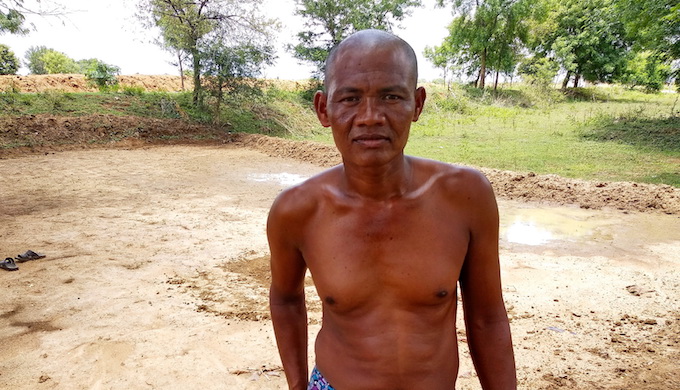
Uddhaba Sabar, a stressed farmer in poverty stricken Naupada district in Odisha, has been facing recurring droughts (Photo by Ranjan K Panda)
Uddhaba Sabar, a stressed farmer in poverty stricken Nuapada district in Odisha, has been facing recurring droughts (Photo by Ranjan K Panda)
“The rain-dependent farmers are reluctant to sow as they are not sure about the monsoon rains. The farmers from western districts of Odisha may still wait for one more month before deciding to migrate in search of alternative jobs,” Ajit Panda, a researcher and social activist in Nuapada, told indiaclimatedialogue.net. “Millions migrate out each year from this region due to the distressed condition of agriculture.”
Sabar’s worry stretches far beyond this year’s situation. He is experiencing a change in climate and an increase in frequency of droughts in the area. “Drought is not new to us, but the frequency in the last two decades is alarming,” he said. “Things started to change from 1965 and frequency of droughts has increased gradually. Between the seventies and nineties, we faced a drought in every eight to ten years, but in the last two decades, droughts are occurring in every 2-3 years.” If the crops fail this year, it will be a consecutive fourth year of drought for Sabar and most other farmers.
A dam can change the game
The Hirakud dam, which is at the centre of controversies in the current dispute between Odisha and Chhattisgarh, might have played a big role in altering local climatic conditions, thereby exposing this region in the basin to more droughts. Arttabandhu Mishra, a retired professor of Sambalpur University and an expert on ecology and climate change issues of the state for long, believes this.
The Hirakud reservoir, completed in 1957, had initiated the process of desertification around the dam, Mishra said. Hirakud reservoir, like many other large reservoirs in the tropical and sub-tropical regions, is home to one of the biggest contributors of greenhouse gas (GHG) emissions. The reservoir submerged a vast stretch of rich and diverse forest, which included Jamda reserve forest and a large portion of the present Debrigarh reserve forest.
“At least 58,200 hectares of forest, rich in teak and sal species, got submerged in the reservoir water,” Mishra told indiaclimatedialogue.net. The trees were never cut and left to decay under the water, which caused huge methane emission, according to him.
Until recently, it was believed that dams and reservoirs contributed nearly 20% of the total man-made methane emissions. However, more recent research says that they contributed 25% more methane emissions than previously estimated.
Microclimatic changes
The woes did not end there. Besides desertification, the Hirakud dam has caused massive microclimatic changes in the region, asserts Mishra. “As a result of the forest submergence and creation of such a huge man-made water body, a lot of moisture gathers around the clouds. So, when the monsoon clouds pass over the reservoir in the northeast, there is a lot of rain. This causes severe and recurring droughts on the other side of the reservoir, that is in the KBK (Kalahandi-Balangir-Koraput) region,” he maintained. Nuapada, Sabar’s district, is in this region that has now become synonymous with drought.
Global climate change, inducing erratic rainfall, is also affecting the Mahanadi basin in a big way. Several scientific studies have been pointing out how global warming is causing severe distress to the basin. A 2010 study, which was conducted using various scientific models, presents a decreasing trend in monsoon rainfall and the flows of the Mahanadi at Hirakud dam.
An earlier study on the Mahanadi also observed a decrease in monsoon stream flow over a long time. One of the possible reasons for such a decreasing trend is the significant increase in temperature due to global warming. Analysis of instrumental climate data has revealed that the mean surface temperature over India has increased at a rate of about 0.4 degree Celsius per century, which is statistically significant.
The reduced flow in the Mahanadi River is causing widespread farm distress (Photo by Ranjan K Panda)
The reduced flow in the Mahanadi River is causing widespread distress to farmers (Photo by Ranjan K Panda)
The state government’s own sources find a substantial increase in temperature in the Mahanadi basin. While in the year 1999-2000, the minimum and maximum temperature of the basin ranged between 7 and 45.5 degrees Celsius, it went up to a range between 13 and 48.8 degrees by 2012. It would have certainly impacted the water retention capacity of the basin in the negative.
A recent study finds that the water yields of major surplus basins, such as Mahanadi and Godavari, have exhibited decreases in recent periods. The water yields show decreases of more than 10% for the Mahanadi. This is mainly because of a significant decrease in rainfall.
Dispute resolution
There is an urgent need to integrate climate resilience models in the river basin management planning of the nation. For Mahanadi, the need is urgent because drought is expanding its grip, marginalising millions of farmers and forcing millions to migrate seasonally. Both Odisha and Chhattisgarh have climate change action plans that need to work in sync with each other to save Mahanadi River, its farmers and other dependent communities from climate impacts.
While the dispute between the two states has been fuelled by apprehension and experience of reduced water flow in the basin due to dams and barrages, the state governments need to recognise that climate change has an equally important effect and its impacts are going to grow manifold. Instead of waiting for the tribunal to come up with a water-sharing formula, the two governments will do far better by initiating joint activities to make the basin more climate resilient, as was recommended by the recently concluded Odisha River Conference, which was attended by community members and experts from across the nation.

This article is reproduction from India Climate Dialogue.  The original article can be accessed at http://indiaclimatedialogue.net/2018/07/16/distress-intensifies-in-mahanadi-river-basin/


=== 
Ranjan Panda
Convenor, Combat Climate Change Network, India

Email: ranjanpanda@gmail.com

Tweet @ranjanpanda
Tweet @MahanadiRiver

Tuesday, December 6, 2016

Drought PIL of Swaraj Abhiyan: Supreme Court Order Dated 1st December 2016

ITEM NO.1                             COURT NO.5 SECTION                                  PIL(W)

S U P R E M E C O U R T O F I N D I A
RECORD OF PROCEEDINGS

Writ Petition(s)(Civil) No(s).857/2015

SWARAJ ABHIYAN                                                                             Petitioner(s)
VERSUS
UNION OF INDIA                                                                               Respondent(s)

(With appln.(s) for interim directions and office report)

Date : 01/12/2016 This petition was called on for hearing today.

CORAM:
HON'BLE MR. JUSTICE MADAN B. LOKUR
HON'BLE MR. JUSTICE N.V. RAMANA

For Petitioner(s) 

Mr. Prashant Bhushan, AOR
Mr. Rohit Kr. Singh, Adv.
Mr. Omanakuttan K.K., Adv.
Mr. T. Sudhakar, Adv.

For Respondent(s)

UOI Mr. Mukul Rohatgi, AG
Ms. V. Mohana, Sr. Adv.
Mr. Ajit Sinha, Sr. Adv.
Mr. Rajiv Nanda, Adv.
Ms. Movita, Adv.
Mr. Mukul Singh, Adv.
Mr. Ajay Sharma, Adv.
Mr. Mukesh Kumar Maroria, AOR
Ms. Diksha Rai, Adv.
Mr. Ajit Singh, Adv.
Ms. Sunita Sharma, Adv.
Ms. Shikha Kumari, Adv.

Mr. Neeraj Kumar Sharma, AOR

Assam 

Mr. Shuvodeep Roy, Adv.
Mr. Sayooj Mohandas M.

A.P. 

Mr. Guntur Prabhakar, AOR
Ms. Prerna Singh, Adv.

Bihar 

Mr. Gopal Singh, AOR
Mr. Manish Kumar, Adv.
Mr. Shivam Singh, Adv.

Chattisgarh 

Mr. Aniruddha P. Mayee, AOR
Mr. A. Selvin Raja, Adv.
Mr. Charudatta Mahindrakar, Adv.

Gujarat 

Ms. Hemantika Wahi, AOR
Ms. Puja Singh, Adv.
Ms. Aagam Kaur, Adv.

Haryana 

Mr. Tushar Mehta, ASG
Mr. Anil Grover, AAG
Dr. Monika Gusain, AOR
Ms. Noopur Singhal, Adv.
Mr. Sandeep Yadav, Adv.
Mr. Arun Tewatia, Adv.

Jharkhand 

Mr. Tapesh Kumar Singh, AOR
Mr. Mohd. Waquas, Adv.
Mr. Aditya Pratap Singh, Adv.

Karnataka 

Mr. V. N. Raghupathy, AOR
Mr. Lagnesh Mishra, Adv.
Mr. Parikshit P. Angadi, Adv.
M.P. Mr. C. D. Singh, AOR
Ms. Sakshi Kakkar, Adv.

Maharashtra 

Mr. Tushar Mehta, ASG
Mr. Mahaling Pandarge, Adv.
Mr. Nishant R. Katneshwarkar, AOR

Odisha 

Mr. Sibo Sankar Mishra, AOR

Rajasthan 

Mr. Vijay Hansaria, Sr. Adv.
Mr. S.S. Shamshery, AAG
Mr. Amit Sharma, Adv.
Ms. Anu Dixit Kaushik, Adv.
Mr. Prateek Yadav, Adv.
Mr. Aankit Raj, Adv.
Ms. Ruchi Kohli, Adv.
Mr. Irshad Ahmad, Adv.

Telangana 

Mr. S. Udaya Kumar Sagar, AOR
Mr. Baskula Athik, Adv.

U.P. 

Mr. Irshad Ahmad, AAG
Mr. Tanmay Agrawal, Adv.
Mr. Vinay Garg, AOR
Mr. Deepam Garg, Adv.
Mr. Upendra Mishra, Adv.
Mr. Varinder Kumar Sharma, AOR


UPON hearing the counsel the Court made the following
O R D E R

It has been pointed out by learned counsel for the petitioner that an application for registration as a political party has been filed by Swaraj India (not by Swaraj Abhiyan) and that is still pending before the Election Commission of India. In view of this, in our opinion, any discussion on whether a public interest petition filed by a political party should be entertained or not appears to be pre-mature as on date. 

List the matter on 18th January, 2017 at 10.30 a.m. for submissions in this regard.

It has been pointed out by the learned Attorney General that pursuant to the order dated 28th October, 2016, a meeting was held by the Secretary in the Ministry of Food and Public Distribution on 9th November, 2016. The Minutes of that meeting have been placed before us. It is in paragraph 8 of the Minutes that in terms of the National Food Security Act, 2013 (for short “the Act”), flexibility is provided to the State Governments for designating some existing Commission to act as the State Food Commission. It is further mentioned that many States have opted for this flexibility and the suggestion given by the Secretary is to the effect that the State Governments should frame Rules to be followed by the designated Commission in its role as State Food Commission. In our opinion, while the flexibility is certainly provided by the Act, the constitution of the State Food Commission, whether it is an independent body by itself or whether it is some other Commission functioning as the State Food Commission, must meet the requirements of the statute. In other words, whatever body it is, it must consist of a Chairman, five Members and a Member-Secretary who shall be the officer of the State Government not below the rank of Joint Secretary to that Government and there should at least be two women, whether Chairperson, Member or Member-secretary and one person belonging to the Scheduled Castes and one person belonging to the Scheduled Tribe, whether Chairperson, Member or Member-Secretary and the eligibility criteria mentioned in Section 16 of the Act should also be met. It is not as if some other body can be described as a State Food Commission even though the members of that body do not meet the requirement of Section 16 of the Act. Learned Attorney General informs us that it was not the intention of the meeting held on 9th November, 2016 to bypass Section 16 of the Act. While that may be so, we are of opinion that the State Food Commission should be constituted at the earliest in accordance with Section 16
of the Act rather than to have some other body function as the State Food Commission without having the necessary expertise or the qualification to function as a State Food Commission. It is stated by the learned Attorney General, on instructions, that the entitlement of foodgrains under the Act, even though it is 75% for the rural areas and 50% for the urban areas but if the rural population or the urban population or both exceed that cut-off percentage, the benefit of the Act is not being denied to the eligible persons as long as they are able to prove their identity. Learned Attorney General further states that as far as the Union of India is concerned, it is providing foodgrains as per the State-wise requirement as mentioned in Annexure A to the affidavit dated 26.10.2016. We take this submission on record. It is submitted by Mr. Prashant Bhushan, learned counsel for the petitioner that the State Governments are not lifting the additional allocated foodgrains since it is being supplied at the Minimum Support Price and not at the price mentioned under the Act. We require the State Governments to file an affidavit within two weeks to indicate why they are not lifting the additional allocated foodgrains. Learned Attorney General has handed over the replies to questions posed by the petitioner in their letter dated 22.09.2016. This is taken on record.

(SANJAY KUMAR-I) (JASWINDER KAUR)
AR-CUM-PS COURT MASTER

Monday, September 14, 2015

Govt. of India's relief plans for farmers affected by deficit monsoon!

Dear Friends/Co-sailors,

Forwarding below a just released information from the Ministry of Agriculture, Govt. of India detailing all steps they have taken to provide relief to farmers in view of the Deficit Monsoon this year.  

Please pass on this information to all possible people/institutions who you think can reach out to affected farmers so that they can avail the benefits.

Thanks and regards,

Ranjan Panda
Convenor, Water Initiatives Odisha
Convenor, Combat Climate Change Network, India
Mahanadi River Waterkeeper (Member, Global Waterkeeper Alliance)

Mob: +91-94370-50103
Email: ranjanpanda@gmail.com

============
Steps Taken by The Central Government for Relief to Farmers in view of Deficit Monsoon

To provide immediate relief to the farmers, in view of the deficit monsoon during kharif 2015,  the Government of India has taken a  number of decisions. Orders on these measures have already been issued to all State Governments, which will implement them on the basis of assessed need.

1.      Allocation of additional days of work under MGNREGA to households in drought affected areas: The Government has decided to provide an additional 50 days of unskilled manual work in the financial year over and above the 100 days assured to job card holders in such rural areas where drought or natural calamities has been notified. This will enable States to provide additional wage employment to rural poor in drought affected areas. The poorest rural households will benefit from this, as it will help in immediate absorption of rural seasonal unemployment, and reduce rural distress.

2.      Diesel Subsidy Scheme for farmers in affected areas : It has been decided to provide diesel subsidy to the farmers to enable them to provide life saving irrigation through diesel pump sets in the drought and deficit rainfall areas to protect the standing crops (allocation of Rs.100 cr). The farmers in the affected regions will  be covered during the current South-West monsoon period till 30th September, 2015.  The scheme on Diesel Subsidy will be implemented with the participation of the State Governments/UT Administration, with a view to offset the cost of diesel used for pumping water for providing supplementary irrigation/protective irrigation. The scheme will be applicable to such districts/talukas/areas where the rainfall deficit is more than 50% as on 15th July, 2015, (as reported by India Meteorological Department); to such districts/talukas/areas, which have been declared as drought affected area by the respective State Govt./ UT Administration; areas with prolonged dry spell continuously for 15 days, i.e. scanty rainfall (deficit of 60% or more of normal) for any continuous 15 days period, after the onset date of Monsoon as per reports of IMD. It is proposed to provide 50% subsidy on the cost of diesel (Rs 2000 per hectare) to the affected farmers, limited to a maximum of two hectares per farmer. The cost of assistance provided shall be shared between the Government of India and the State Government/UT Administration concerned on 50:50 basis.

3.      Enhancement of ceiling on Seed subsidy. In order to  compensate the farmers in the drought affected districts for the additional expenditure incurred in the sowing and /or purchasing appropriate varieties of drought resistant seeds it has been decided to raise the extant ceiling on seed subsidy by 50%  over existing levels for distribution in drought notified districts. The enhancement is valid till 31.12.2015.

4.      Interventions for saving perennial horticulture crops: Appropriate input support measures will be provided to rejuvenate water stressed horticulture crops, with an additional allocation of Rs.150 crore. The scheme is to be implemented in all drought affected districts / blocks in the country which are covered under Mission for Integrated Development of Horticulture (MIDH), being implemented by Dept. of Agriculture, Cooperation& Farmers Welfare. Farmers in the drought affected districts/ blocks will be provided assistance @ Rs.6000/- per hectare as per cost norms for a maximum area of two ha per beneficiary for taking up appropriate combination of interventions. Assistance so provided through subsidy shall be shared between the Government of India and the State Government/UT Administration concerned on 50:50 basis.

5.      Implementation of additional fodder development programme: Assistance will be provided for additional interventions for production of fodder for mitigating adverse impact of drought on livestock (allocation of Rs.50 crore) . Farmers in the drought affected districts/ blocks will be provided assistance @ Rs.3200/- per hectare as per cost norms for a maximum area of two ha per beneficiary for taking up additional production of fodder in these districts/blocks. Assistance so provided through subsidy shall be shared between the Government of India and the State Government/UT Administration concerned on 50:50 basis.

6.      Flexible allocation under RKVY and other centrally sponsored schemes: States have   been advised to keep aside about 5 to 10% of fund allocated under Rashtriya Krishi Vikas Yojana (RKVY) for undertaking appropriate interventions, if the situation so warrants, to minimize the advance impact of an aberrant monsoon on the agriculture sector. 10% of the allocation under Centrally Sponsored Scheme may be utilized in flexible manner by the States to meet contingent requirement arising out of deficient rains.

7.      Crop contingency plan : Ministry of Agriculture, through ICAR-Central Research Institute for Dryland Agriculture (CRIDA), Hyderabad has prepared detailed crop Contingency Plans for 600 districts. States have been advised to prepare/ update/ fine-tune Contingency Plans for each district in consultation with CRIDA-ICAR and the State Agriculture Universities and to prepare location specific remedial measures based on these contingency plans in the event of late arrival of Monsoon/long dry spells/scanty rainfall/drought conditions e.g. tying up availability of seeds and other inputs for implementing the Contingency Plans. As seen from the experience of last year, these are highly useful in case of a deviant monsoon.  These plans are available at the website of Dept. of Agriculture & Cooperation, Min. of Agriculture as well as Central Institute for Dryland Agriculture (CRIDA), Hyderabad.

8.      Advisories to the states: State Governments have already been advised to initiate advance remedial action e.g.  constructing water harvesting structures under MGNREGA  and other such schemes, promoting agronomic practices for moisture conservation, promoting cultivation  of less water consuming crops and restoring irrigation infrastructure by desilting canals, energizing tube-wells, replacing/repairing faulty pumps. States have also been requested to carry out periodic assessment of preparation for kharif crops, particularly contingency crops and also investment made in water conservation structure under various schemes like Integrated Watershed Management Programme(IWWP) to verify their utility in harvesting the rainfall.

9.      Availability of seeds and other inputs for kharif, 2015 : Availability of seeds and other inputs is being monitored / reviewed on a continuous basis in the weekly Crop Weather Watch Group (CWWG) Meetings being held in the Department of Agriculture. Weekly video conference with States is also being held to get first-hand information about State’s preparedness and to advise States appropriately whenever needed.

10.  SMS Advisory: The Ministry, through the m-kisan portal sends SMS advisories to registered farmers. These advisories include weather based SMS advisories, advisories to suggest measures to minimize adverse impact of extreme weather event. Ministry through various operators sent about 700 crores SMS in last one year. These SMS are sent by ICAR/SAU, KVK, AMFU etc and district level state govt officials.

11.  Crisis management plan for drought for the year 2015: A Crisis Management Plan (CMP) for Drought has been in place and is available at the website of Dept. of Agriculture & Cooperation, Min. of Agriculture. The plan has also been updated recently in consultation with Stakeholder Ministries/Departments. Agriculture Minister has also requested all Chief Ministers, vide his letter dated 12.05.2015, to direct the officers concerned to expedite preparation of State level Management Plans on Drought.

12.  SDRF/NDRF funds - First Instalment of SDRF released : The State Government is primarily responsible for providing  necessary relief in the wake of natural calamities. Government of India supplements the efforts of state Governments with financial assistance. For undertaking relief measures, funds are available with the State Governments in the form of State Disaster Response Fund (SDRF). Additional financial assistance, over and above SDRF, is considered from National Disaster Response Fund (NDRF) for natural calamities of severe nature and is approved on the basis of Memorandum  received from State Government in accordance with established procedure, keeping in view items and norms in vogue for assistance. The 1st instalment of SDRF has already been released to State Governments.The SDRF funds, besides others, can also be used for emergency supply of drinking water in rural and urban areas, as per the approved guidelines.

Source: PIB Release 14-September-2015 19:11 IST